Late have I loved thee
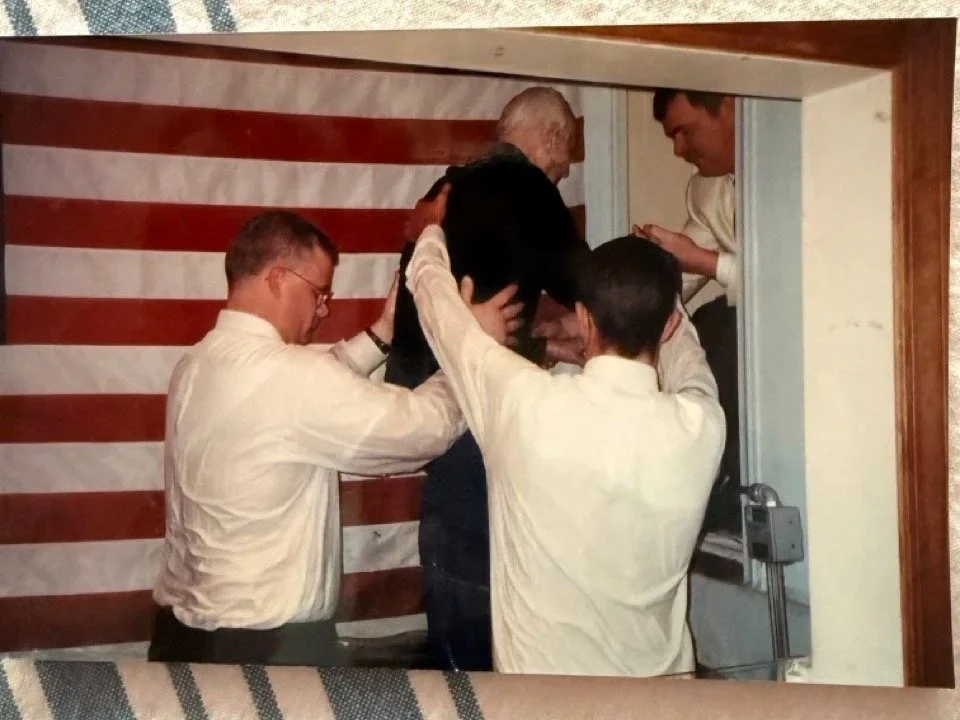
My great-grandpa, Clarence Capps, at his baptism
My son asked me this morning at the breakfast table, “If someone doesn’t follow Jesus for their whole life, but believes in Him right before they die, do they still get to be with Him?”
I smiled, “I have something amazing to show you. Wait right here.”
I hurried to the next room and shuffled through a stack of papers. I lifted out a glossy photo I had found in an old shoebox in beloved great-aunt and uncle’s house after their passing.
I came back to the table and the kids gathered around me.
“Do you see that man?” I asked, pointing a frail-looking man being helped out of small pool of water. “What color is his hair?”
“White,” they replied.
“Does he look really old to you?” I asked. They nodded.
“So old,” I added, “that it took three men to help him out of the water when he was baptized.” Their eyebrows lifted.
“Who is that man?” they asked.
“It’s your great-great-grandfather.”
I told them that for his whole life, he wasn’t really interested in knowing God. He didn’t really see what Jesus had to do with him. After all, he was a good man. He worked hard. He wasn’t in need of saving. For decades, my aunt and uncle told him about the love of God, the healing and wholeness and life upon life God was offering him in Christ. Every time, he brushed them off.
Until one day when he was in his eighties, he didn’t. My great-grandpa finally, simply “believed on the Lord Jesus, and [was] saved” (Act 16:31). All those years of resistance—of indifference—wiped away in a moment by the blood of Christ.
He died just a few months later.
“But in that moment, he belonged to Christ just as fully, just as surely, as you or me,” I told them. “It didn’t matter that for all but a few months of his life, he had been living apart from God. He is now with Him forever.”
Then we remembered the thief—guilty, minutes from death—who was crucified next to Jesus and asked Him to remember him when He came into His kingdom. We marveled together at Jesus’s response: “Today, you will be with me in paradise” (Luke 23).
Wiggles in their seats signaled their readiness to go play. I could have concluded by saying, “And that’s why you should never stop praying for those who don’t know Jesus.” And certainly that is true. It is our sacred privilege and duty as those who belong to the Shepherd who leaves the 99 in the fold to find the one sheep who went astray.
I could have said, “And that’s why it is never too late to turn to God.” And certainly that is true too, and I want my kids to know it with all their hearts. Our God is “patient toward [us], not willing for any to perish, but for all to come to repentance” (2 Peter 3).
Instead, I said simply, “And that’s what God’s love is like.”
Matthew 20 records a story Jesus told His disciples to show us what kind of King He is and what His Kingdom is like. In it, the master of the vineyard gives the workers who arrived at the 11th hour the same wages as those who had been laboring since morning, toiling for hours in the heat of the day.
The workers who had worked all day were furious. But Jesus said to them,
“Friend, I am doing you no wrong. Did you not agree with me for a denarius? Take what belongs to you and go. I choose to give to this last worker as I give to you. Am I not allowed to do what I choose with what belongs to me? Or do you begrudge my generosity?”
In the millennia-long Story of God’s redeeming work in this world, we Gentiles are the latecomers to the game, the ones who showed up at the 11th hour, the ones who have been grafted into the long lineage of the family of God by the blood of Christ. And yet, we have not received a lesser inheritance. Grace upon grace.
“Am I not allowed to do what I choose with what belongs to me?” the master of the vineyard in Jesus’s story asks. I hear this question echoed in Jesus’s proclamation to His disciples after He defeated death: “All authority in heaven and earth has been given to me” (Matthew 28). And what does Jesus do with this divine authority? He offers us what only He has the power to give: a share in the royal priesthood of all believers, a place of belonging in His Kingdom, and the promise that when He, “who is [our] life appears, then [we] also will appear with Him in glory” (Colossians 3).
The lateness of the hour is irrelevant to a God of such abundant generosity. All of us, even those who have been given the grace of knowing God our entire lives, can testify alongside St. Augustine:
“Late have I loved you, O Beauty ever ancient, ever new, late have I loved you! You were within me, but I was outside, and it was there that I searched for you…You called, you shouted, and you broke through my deafness. You flashed, you shone, and you dispelled my blindness...I have tasted you, now I hunger and thirst for more.”
God ever extends His earnest invitation to those He has made to journey “further up and further in” into the divine life of God. Out of His inseparable generosity and power, He offers us who have arrived late in the Story of redemption the fullness of Himself with nothing held back.
And that’s what God’s love is like.